
Hosts

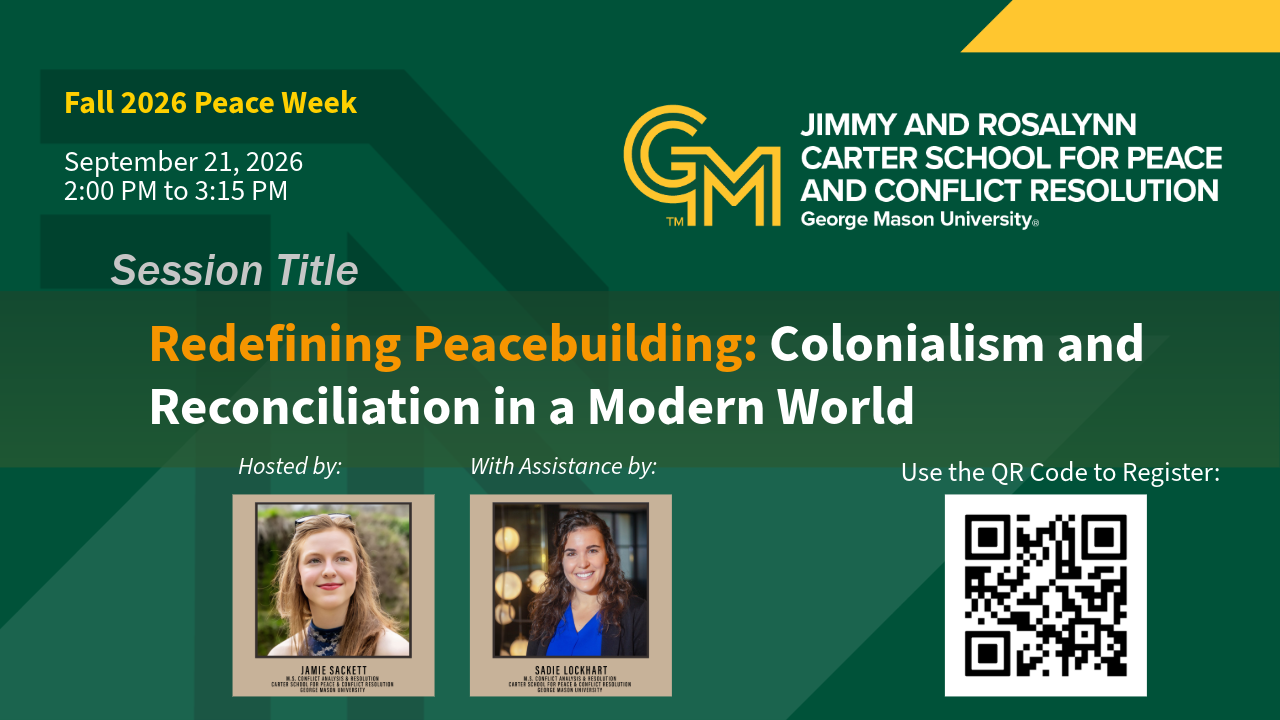
Silvestre Acedillo, RTC Founder and Primary Roundtable Host | Jamie Sackett, RTC Member and Co-Host | Sadie Lockhart, RTC Member and Co-Host
Session Synopsis
Peacebuilding is commonly understood as a practice of repair: rebuilding institutions, restoring relationships, supporting reconciliation, protecting vulnerable populations, and preventing renewed violence. Yet peacebuilding is never separate from the systems of knowledge, authority, funding, and technology through which it operates. Its institutions may advance justice and local agency, but they may also reproduce hierarchy, dependency, external control, surveillance, or unequal definitions of whose knowledge and vulnerability matter.
This roundtable examines the conditions under which peacebuilding fulfills its emancipatory promise and the conditions under which it reproduces colonial or authoritarian relationships. The discussion brings critical and decolonial approaches to peace into conversation with research and practice in human trafficking, migration governance, institutional peacebuilding, digital authoritarianism, and community-centered development. It asks how donor priorities, externally designed programs, victim-identification systems, peacebuilding institutions, and digital technologies shape who is protected, who participates in decision-making, and who remains vulnerable to exploitation or exclusion.
The roundtable does not begin from the assumption that international peacebuilding should be rejected. Nor does it romanticize institutional withdrawal or the weakening of international support. Instead, it explores how peacebuilding can move beyond externally imposed models while continuing to support civil society, social movements, and communities confronting authoritarianism, displacement, exploitation, and political fragmentation.
The central challenge is therefore constructive as well as critical:
"How can peacebuilding become more accountable, plural, locally grounded, and responsive to lived realities without abandoning the solidarities and institutions necessary to protect civic space and sustain peace?"
Roundtable Format
This session will be conducted as a moderated live roundtable rather than a sequence of formal presentations. Featured participants will respond to guiding questions, engage one another’s research and practice, and contribute as the conversation develops. Brief opening reflections are welcome, but prepared remarks are not required.
The format is intended to encourage intellectual exchange across disciplinary and professional boundaries. Participants and attendees will be invited to examine points of convergence, productive disagreement, and possible pathways for reimagining peacebuilding practice.
Four Intersecting Tensions
Peacebuilding as Protection vs. Protection as Governance
Peacebuilding and humanitarian systems seek to protect people affected by violence, displacement, trafficking, unsafe migration, and institutional instability. Yet systems of protection also define vulnerability, determine eligibility for assistance, collect information, and establish who possesses the authority to intervene.
The roundtable will examine how anti-trafficking and migration-governance systems may reproduce donor dependency, institutional bias, paternalism, or narrow definitions of victimhood. It will also consider how lived experience and locally situated knowledge can inform more accountable systems of protection.
Peacebuilding as Repair vs. Peacebuilding as Governance
Peacebuilding may help societies restore relationships, rebuild institutions, and prevent renewed violence. At the same time, programs designed around stabilization, institutional capacity, or risk management may consolidate elite authority, legitimize illiberal institutions, or prioritize order over democratic participation.
Peacebuilding as Inclusion vs. Peacebuilding as Coloniality
Peacebuilding is not inherently colonial, but it may reproduce colonial relationships when external actors define problems, treat conflict-affected communities as objects of management, privilege Global North expertise, or marginalize local and Indigenous knowledge.
The roundtable will ask whose knowledge becomes authoritative, who determines what peace should look like, and whether participation meaningfully redistributes decision-making power or merely legitimizes externally designed programs.
PeaceTech as Empowerment vs. PeaceTech as Surveillance
Digital platforms, artificial intelligence, data systems, and monitoring technologies can support early warning, documentation, coordination, and community participation. The same infrastructures can also enable surveillance, profiling, data extraction, censorship, or dependency on institutions and technologies that communities do not control.
The discussion will explore when digital peacebuilding expands agency and when it becomes an infrastructure of control. It will also examine what democratic, rights-based, and community-governed technology might require.
Guide Questions
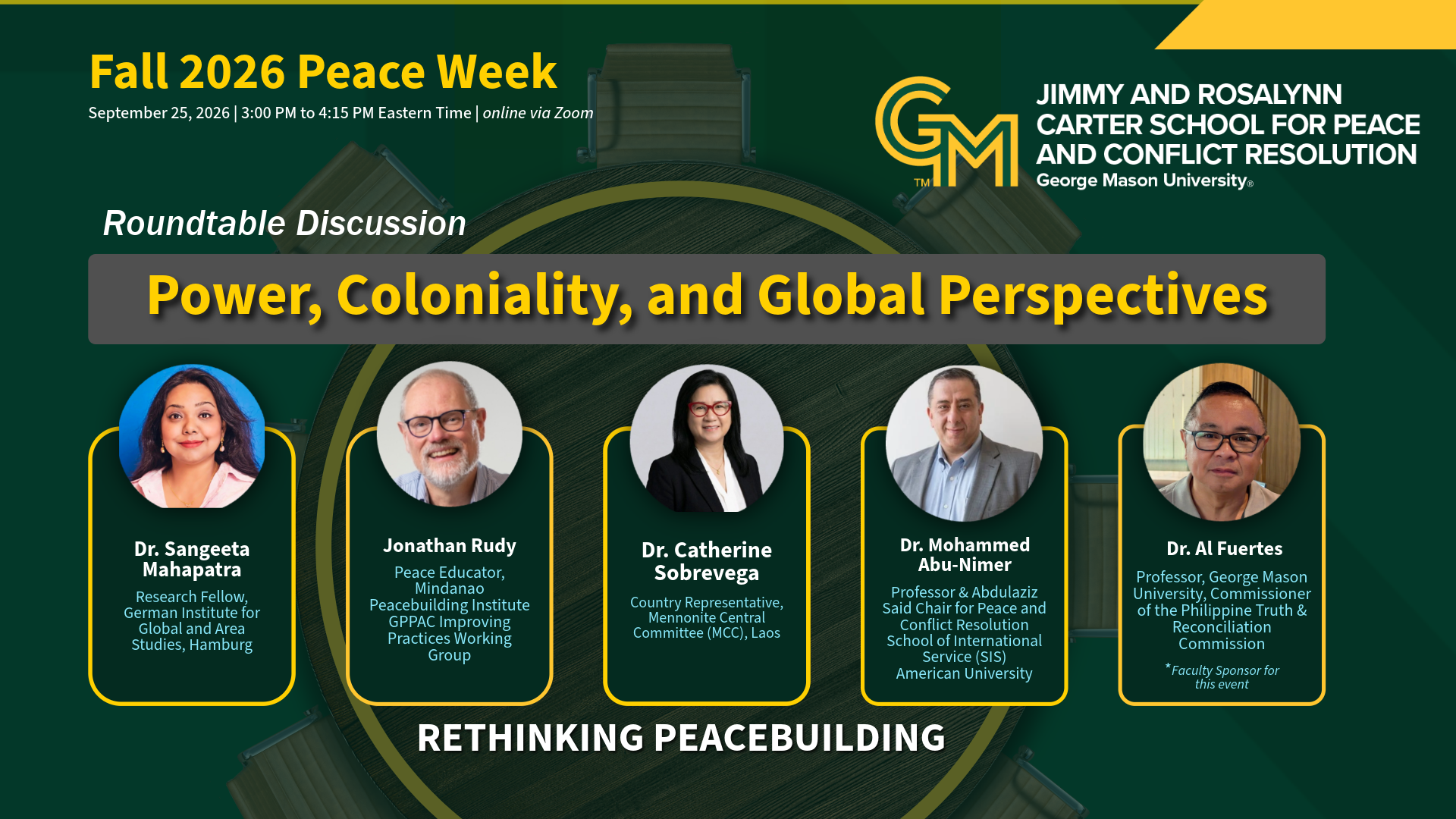
For the Human Trafficking and Migration Governance Scholar-Practitioner
Focus:
Human trafficking, labor migration, displacement, and exploitation
Anti-trafficking governance and the politics of protection
Donor influence, institutional bias, and victim identification
Local knowledge and lived experience in policy design
What does human trafficking reveal about the limits of peacebuilding and protection systems, and how can anti-trafficking governance address exploitation without reproducing donor dependency, institutional bias, or external control?
For the Decolonial Theorist / Critical Scholar
Focus:
Coloniality of peace
Epistemic power and Global North dominance
Critique of liberal peace frameworks
Under what conditions does peacebuilding reproduce colonial relationships of knowledge, authority, and external assistance?
For the Practitioner / Policy Expert
Focus:
Peacebuilding programs led by international institutions, NGOs, and local initiatives
Trade-offs among stability, democratic accountability, inclusion, and institutional authority
Lessons from design, implementation, monitoring, and evaluation
When does digital peacebuilding expand participation, and when does it become an infrastructure of surveillance, extraction, or control? What would accountable digital governance require?
Learning Objectives
Critically evaluate dominant peacebuilding frameworks
Identify how conventional approaches may reproduce unequal power relationships, including colonial, authoritarian, extractive, or paternalistic dynamics.
Examine trafficking and migration through a peacebuilding lens
Assess how conflict, displacement, precarious labor, donor agendas, and institutional definitions of vulnerability shape exposure to exploitation and access to protection.
Explain the coloniality of peace
Describe how historical and structural inequalities continue to shape contemporary peacebuilding knowledge, institutions, and practice.
Analyze peacebuilding as a form of governance
Evaluate how institutional priorities, funding structures, program design, and decision-making authority affect legitimacy and local agency.
Assess the relationship between digital technology and power
Examine how digital tools may empower communities while also enabling surveillance, profiling, data extraction, censorship, or digital dependency.
Apply a fragmentation lens to peacebuilding practice
Analyze how political, social, institutional, economic, and informational fragmentation affects peacebuilding outcomes.
Identify pathways toward accountable peacebuilding
Consider approaches grounded in community agency, epistemic pluralism, democratic accountability, ethical technology use, and institutional responsibility.
Contribution to the Fall 2026 Peace Week Theme
This roundtable directly advances the Fall 2026 Peace Week theme, Peacemaking and Peacebuilding in a Fragmented World, by:
~ Examining fragmentation not only as a condition peacebuilding seeks to overcome, but also as a condition peacebuilding may inadvertently reproduce;
~ Connecting macro-level concerns, including democratic erosion, authoritarianism, geopolitical rivalry, and international institutional legitimacy, with micro-level practices involving victim identification, local engagement, data collection, funding, and knowledge production;
~Bringing human trafficking, migration governance, coloniality, institutional peacebuilding, and digital power into one interdisciplinary conversation;
~ Treating civil society and conflict-affected communities as knowledge producers and political actors rather than simply as beneficiaries of outside assistance;
~ Developing constructive pathways for peacebuilding that is not only stable, but also just, plural, accountable, and locally grounded.
Central Roundtable Question
"How can peacebuilding move beyond hierarchy, dependency, and coloniality while protecting civil society, local agency, and democratic accountability in an increasingly fragmented world?"
About the Companion Writing Series
The Roundtable Consortium has launched a companion public-scholarship series, Rethinking Peacebuilding in a Fragmented World, to develop the roundtable’s central questions before the September discussion.
The series examines:
~ Peacebuilding as repair and governance;
~ Digital power and the politics of protection;
~ International peace architecture and counter-peace;
~ Human trafficking as a peacebuilding question;
~ Accountable accompaniment as a possible alternative to both external domination and institutional abandonment.
The published essays provide intellectual context for the roundtable but do not prescribe participants’ positions or limit the direction of the live discussion.

(Click on the image to be taken to our Substack Platform)